
Mostly seen on TV or in animated movies, sea turtles are extremely charismatic animals and beloved by many. When most people think of sea turtles they picture long flippers, a small head, and a big smooth shell. While this is pretty close to the sea turtle body plan there are actually seven different species and they all look different!
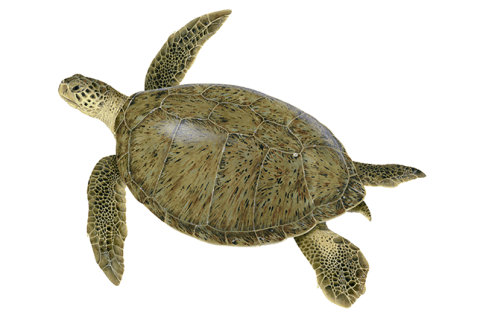
One of the most famous sea turtles is the green sea turtle. Though not actually green, they are named after their globs of green fat inside their bodies. This may sound like a pretty strange way to name an animal, but believe it or not green sea turtles were once harvested for their meat and still are in some places. Green turtles most closely resemble the turtles in our imaginations, with a small head and a big almost three-foot long shell. These turtles have a smaller head because they are herbivores and don’t need to crush their prey like other species, instead they clip seagrass and algae, using their mouth like garden shears.
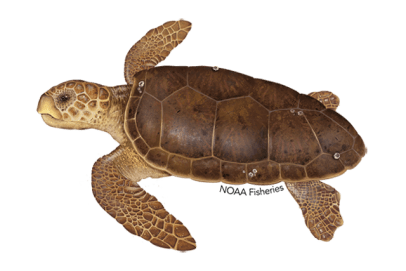
Another species is the loggerhead sea turtle. It’s easy to see how they got their name because their heads are HUGE and built for crushing crabs, clams and other hard-shelled prey. Loggerheads shells are similar in size to green sea turtles but they are often covered in lots of algae, barnacles and other small creatures. These small passengers are known as epibionts, meaning an organism that lives on the surface of another living organism, and they give the turtle a crusty appearance.

The most beautiful of all the sea turtles is the hawksbill. The hawksbill sea turtle is named after its hawk-like beak. This beak is perfect for feeding in tight spaces on coral reefs where the turtle can eat its favorite food, sea sponges! These turtles have a spectacular pattern on their shells and for a long time were the source of “tortoiseshell” products. They were so in demand for their gorgeous shells that they are now critically endangered.


The smallest of the sea turtles are the ridleys. They represent two separate species, the olive ridley and Kemp’s ridley. Both species, when full grown, are the about the size of the garbage can lid and have mass nesting events where thousands of turtles can be on the beach at once. They may be similar in size but both turtles live in very different parts of the world. The olive ridley is considered to be the most abundant of the sea turtles and can be found in the Pacific, Eastern Atlantic and Indian oceans. The Kemp’s ridley, on the other hand, is the rarest and most endangered sea turtle in the world, only nesting on a few beaches in Mexico and Texas! Check out this great video from National Geographic of an olive ridley nesting below!

The sixth species of turtle is the largest! The leatherback sea turtle is one of the largest reptiles in the world. Growing to lengths of seven feet long and weighing up fifteen hundred pounds. Though huge they survive on a diet of only eat jellyfish! The leatherbacks get their name from having a soft and leathery shell that is specially evolved to compress during deep dives. Looking more like a dinosaur then a turtles these huge animals are truly a sight to behold.

The seventh species of turtle is the most mysterious. The flatback sea turtle, named for its relatively flattened shell, is found only off the coast of Northern Australia. It nests on very remote beaches and very little is know about its life history.
Let me know what your favorite species is in the comments below!
 My Time With Turtles
This is so informative and necessary! Im glad you picked a topic that not many people focus on and often overlook. I learned so much in such a short period of time. I cant wait for your podcasts because now I do want to know how to improve my habits so that I can also help the turtles. GREAT JOB!!!!!
LikeLike
Wow, I did not know there were so many different species of sea turtles. I am very impressed by the dinosaur-type one! I was also wondering whether their lifespan differs a lot? For example, is the herbivorous green sea turtle living longer than the carnivorous ones? Really liked the video too, thank you for sharing it.
LikeLike
Very cool post! I love that you gave some great background on all the different species of sea turtles! I agree, I think a lot of people don’t realize there are different types of sea turtles. I think this is a great post for anyone who wants to know some more about sea turtles and it is very easy to read! Great job.
LikeLike
Informative. Never know that there were so many varieties of sea turtles. Thanks for posting. I happened to watch several videos on you-tube showing how human activity in the sea is adversely affecting the life of these creatures. They get entangled in old finishing nets made of plastic disposed off in the sea. Global warming and pollution of water is also causing huge damage to their habitat.
LikeLike