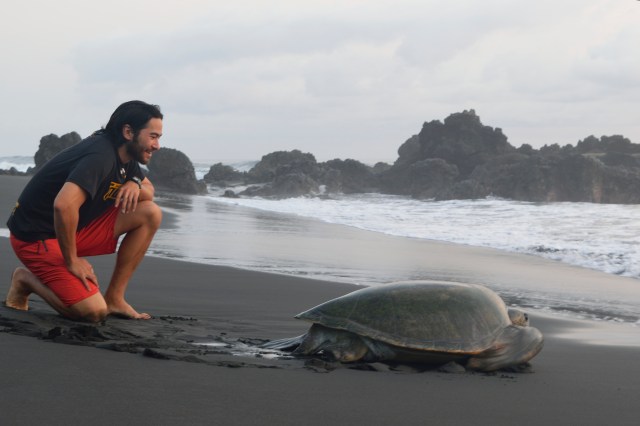
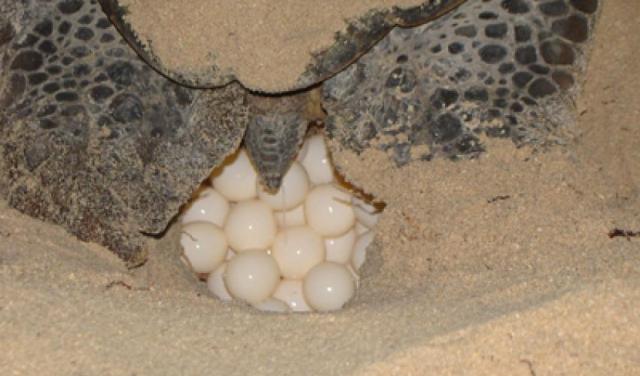
Seeing a sea turtle nest is a captivating and mesmerizing experience. As they haul themselves out of the surf, they go from a graceful swim to a slow and methodical crawl. It is at this moment in the turtle’s adult life that she is at her most vulnerable. Defenseless and out of her natural element, she is returning to the foreign landscape that hatched her. Entering a trance-like state, she makes a nest and lays her eggs. During this crucial segment of her life cycle, with instincts focusing her on the task at hand, she is safe to approach. After putting the final touches on her nest, researchers begin to scramble around her. Being careful not to disturber her, they collect as much data as they can. Measurements are taken and identification tags are applied in hopes of seeing her again.
It was an experience much like this one on the black sand beaches of Costa Rica that sparked my enthusiasm for marine conservation. After completing my first internship with a conservation project, I jumped from program-to-program, timing each new opportunity with the nesting season of a different species of sea turtle. My work with various conservation organizations has spanned nearly four years and taken me to the beaches of Central America, Western Africa, the Caribbean, and the United States. I have been very fortunate to work in amazing places with unforgettable people and each experience has further increased my passion for sea turtles and the ocean.
A lot of sea turtle action takes place at night. The majority of sea turtle species nest in the cover of darkness and this is also typically when hatchlings make their mad dash to the ocean. You would figure the sea turtles would appreciate a little more light but that is not the case.
For millions and millions of years, sea turtles have evolved with only the moon to light their nocturnal activities. New human caused additions don’t make it easier but rather make things very difficult for sea turtles. Evolved to use the light of the moon for navigating the beach, modern artificial lights can confuse both adult and hatchling sea turtles, sometimes with disastrous effects. For adult turtles, excess lights can cause turtles to crawl in odd directions, often in the opposite direction of the water. Sometimes nesting female turtles will crawl parallel to the water for hundreds of feet, which can be exhausting for these three hundred pound moms, using valuable energy that can be devoted to making another clutch of eggs.
For hatchling sea turtles, lights on the beach cause a similar response to adults but for these tiny turtles heading in the wrong direction often proves fatal. On a natural beach when a sea turtle nest hatches, baby turtles will head for the lightest part of the horizon, this often is the ocean as it reflects the light of the moon. When there are artificial lights on the beach the turtle’s head towards the light source, rather than the water. This can disorientate them and exposes them to more predation, exhaustion, and dehydration. This often leads to baby turtles stuck in vegetation, on busy roads or even in swimming pools.
How can we fix this problem? The best solution is to turn off beachfront lights during sea turtle nesting season. This can help negate light pollution and make the beach appear more natural to sea turtles. Another option, where everyone wins, is replacing bright white lights with red or amber ones. Sea turtles can’t see the red wavelength of light very well, so using a red or amber bulb will not harm or confuse them. The use of red and turtle friendly lighting allow beachgoers to see at night and turtles to nest and hatch. Please check out this very informative video for the Sea Turtle Conservancy below!
I’m sure you already know about climate change and the effects it can have on the ocean. But how will it affect sea turtles?
Rising seas will definitely affect sea turtles. As the climate warms and sea ice melts, rising tides could damage nesting beaches. Also, climate change can lead to more frequent storms, bad news for sea turtles that like to nest on tropical and subtropical beaches. Strong hurricanes and typhoons can devastate beaches and can even wipe out entire islands that are important nesting sites for turtles. The list of problems that climate change can cause for turtles goes on and on, but one that people often forget is that temperature determines if a turtle is going to be female or male.
ICUN
During development inside the egg, there is a critical period when the turtle embryo will be a male or a female and the temperature at which the eggs are incubating determines this. If the nest it too hot, there will be more females and if the nest is too cold, then there will be more males. As the climate warms this poses a major problem for sea turtles. If global temperatures rise too much it is possible that all the sea turtles born will be female, shifting the sex ratio and potentially leading to extinction by lack of males. Check out this great video by National Geographic for more details!
Most people really like sea turtles and for good reason, these charismatic marine reptiles are truly amazing creatures. Unfortunately, most sea turtle species are endangered, and they need our help. Even if you don’t live by the ocean there are three, small, easy steps that you can take each day to help save our undersea friends.
Step One
Become a conscious and responsible consumer of seafood. You can do this by learning or asking where and how your seafood was caught. It is best to choose seafood caught in ways that do not harm or kill turtles. A good place to learn some of this information is through sustainable seafood information networks like the one run by the Monterey Bay Aquarium, which can be found a http://www.seafoodwatch.org
Step Two
Recycling and limiting single-use plastics so you can help to reduce marine debris that may be accidentally eaten by sea turtles. An easy way to do this is to start using reusable water bottles and shopping bags. The easiest step you can take is by not using a plastic straw. When eating at a restaurant simply let your waitress or waiter know by saying, “no straw please”. These three easy words can help cut down on the plastics that find their way into the ocean. If you really, really like using a straw there are plenty of reusable products available for purchase online.
Step Three
Please avoid releasing balloons, they will most likely end up near or in the ocean where sea turtles can mistake them for prey and eat them. While releasing balloons can seem like a fun event to do at a party, not many people realize that these balloons can travel very far distances on air currents and will eventually pop. When these balloons pop and their fragments make it into the ocean the can pose a major threat to young sea turtles as they confuse them for food and can become very sick from eating them. Please check out this shocking video of plastics floating in the ocean near Indonesia!
I hope you all can do your part to help save sea turtles. Just remember no matter how far away you are from the ocean or a sea turtle there are quick changes we can make to our daily lives that can help benefit the ocean and the turtles that live in it!
According to the ICUN (International Union for Conservation of Nature), which is the “global authority on the status of the natural world and the measures needed to safeguard it”, six out of seven species of sea turtles are vulnerable or endangered. The seventh species, the flatback sea turtle, is so mysterious that they can’t even determine its status and label it as “data deficient”.
How did sea turtles become so imperiled? Why is this happening? The answer can be boiled down into two sections. One is due to the turtle’s life history and the other is humanity.
This may sound strange, but when you look at how sea turtles live and reproduce it reveals why they are in trouble. One reason for this is that sea turtles take a very long time to reach maturity and some turtles don’t lay eggs till they are forty years old! These animals take an incredibly long time to reproduce and it can take decades upon decades for a population to grow. Another reason is that at birth, the odds are stacked against baby sea turtles. It is estimated that only one out of one thousand baby turtles will make it to adulthood. This is because they must survive many, many years before they are mature and also have to contend with an ocean full of predators. Please check out this awesome animated video by TED-Ed for a great explanation about the life cycle of sea turtles and the challenges they face!
This brings us to the human element. Humans have used sea turtles as a food source since man first inhabited tropical coastal areas. Consuming turtle eggs and harvesting them for their meat, humans soon began to overexploit the sea turtles. As mentioned before, sea turtles already have a tough time as it is, but when factoring in humans and their consumption, things start to look bleak. Historically many subpopulations of sea turtles have collapsed due to over-harvesting and in some places where turtles once nested in the thousands, they are seldom seen.
Another way humans are impacting sea turtles is through pollution. The ocean may be huge but the things we put in it can have major impacts on sea life, specifically plastics. Plastics are very deadly for turtles, young and old. When plastics break apart into small pieces they can look just like plankton, a favorite food of baby sea turtles. When the small turtles ingest too much plastic they can form a blockage inside the turtle’s body and eventually kill them. For adult turtles, a plastic bag can look just like one of their favorite foods, jellyfish. When adult sea turtles consume plastic, they meet a similar fate as the young turtles, usually choking or dying of impaction.
This piece may not be very fun, but it highlights real issues that sea turtles face. Come back and read my next entry for ways that you help save sea turtles and do your part to keep them from going extinct!
Mostly seen on TV or in animated movies, sea turtles are extremely charismatic animals and beloved by many. When most people think of sea turtles they picture long flippers, a small head, and a big smooth shell. While this is pretty close to the sea turtle body plan there are actually seven different species and they all look different!
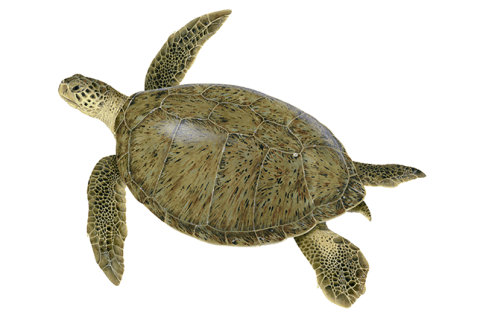
Green Sea Turtle (NOAA).
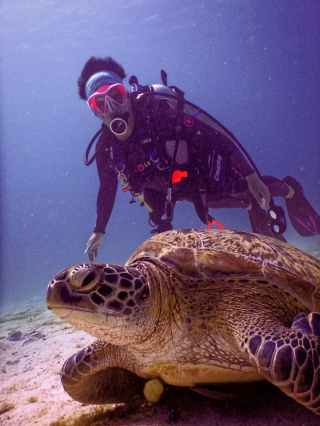
One of the most famous sea turtles is the green sea turtle. Though not actually green, they are named after their globs of green fat inside their bodies. This may sound like a pretty strange way to name an animal, but believe it or not green sea turtles were once harvested for their meat and still are in some places. Green turtles most closely resemble the turtles in our imaginations, with a small head and a big almost three-foot long shell. These turtles have a smaller head because they are herbivores and don’t need to crush their prey like other species, instead they clip seagrass and algae, using their mouth like garden shears.
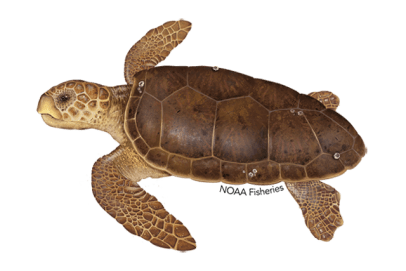
Loggerhead Sea Turtle (NOAA)
Another species is the loggerhead sea turtle. It’s easy to see how they got their name because their heads are HUGE and built for crushing crabs, clams and other hard-shelled prey. Loggerheads shells are similar in size to green sea turtles but they are often covered in lots of algae, barnacles and other small creatures. These small passengers are known as epibionts, meaning an organism that lives on the surface of another living organism, and they give the turtle a crusty appearance.
Hawksbill Sea Turtle (NOAA)
The most beautiful of all the sea turtles is the hawksbill. The hawksbill sea turtle is named after its hawk-like beak. This beak is perfect for feeding in tight spaces on coral reefs where the turtle can eat its favorite food, sea sponges! These turtles have a spectacular pattern on their shells and for a long time were the source of “tortoiseshell” products. They were so in demand for their gorgeous shells that they are now critically endangered.
The smallest of the sea turtles are the ridleys. They represent two separate species, the olive ridley and Kemp’s ridley. Both species, when full grown, are the about the size of the garbage can lid and have mass nesting events where thousands of turtles can be on the beach at once. They may be similar in size but both turtles live in very different parts of the world. The olive ridley is considered to be the most abundant of the sea turtles and can be found in the Pacific, Eastern Atlantic and Indian oceans. The Kemp’s ridley, on the other hand, is the rarest and most endangered sea turtle in the world, only nesting on a few beaches in Mexico and Texas! Check out this great video from National Geographic of an olive ridley nesting below!
Leatherback Sea Turtle (NOAA)
The sixth species of turtle is the largest! The leatherback sea turtle is one of the largest reptiles in the world. Growing to lengths of seven feet long and weighing up fifteen hundred pounds. Though huge they survive on a diet of only eat jellyfish! The leatherbacks get their name from having a soft and leathery shell that is specially evolved to compress during deep dives. Looking more like a dinosaur then a turtles these huge animals are truly a sight to behold.
Flatback Sea Turtle (NOAA)
The seventh species of turtle is the most mysterious. The flatback sea turtle, named for its relatively flattened shell, is found only off the coast of Northern Australia. It nests on very remote beaches and very little is know about its life history.
Let me know what your favorite species is in the comments below!
Jaron Lanier & Ten Arguments For Deleting Your Social Media Accounts Right Now
Jaron makes multiple compelling arguments for ridding your life of social media. His extensive background in tech gives him valuable insight as a person who has seen and done it all and was there on the ground floor during the birth of the Internet. He offers a unique perspective from inside the industry and his deep understanding of the nuances and driving forces behind social media cannot be denied. While all his points were valid and well thought out, he can sometimes come across as someone who was too invested in the cause.
As someone who is not that active of a participant in social media, I personally felt his detailed understanding of the issues social media has made his opinions somewhat unrelatable. It felt to me that he was so immersed in the culture and industry that he dwells too much on the negative aspects of social media. Though I agree with some of his opinions and enjoyed his eye-opening takes on social media platforms, it often felt as if he is someone who has seen the worst of what social media has to offer and it had really affected him.
Though I personally don’t immerse myself in social media platforms I feel like they have their value and are a good way to stay in touch with friends, family, and colleagues. I agree with Jaron that social media is not perfect but maybe suggesting moderation is a more even-keeled approach.
Like anything that gives joy or captivates you, social media can be addicting. Even though it seems algorithms may be conspiring against you, you still have the choice of logging off. Maybe it can be healthy and refreshing to unplug for a while and take a break from it all. Perhaps watch something that makes that you smile, like how I feel when I see this video of Jaron Lanier performing a double flute solo.






 My Time With Turtles